Education
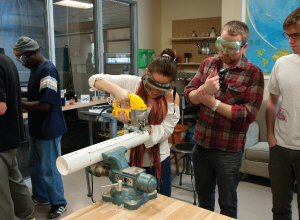
Instruction in energy related fields is offered through numerous undergraduate, graduate, and extension programs. In addition, the Institute has proposed the establishment of an Energy Graduate Group along with undergraduate minors in energy. The Energy Efficiency Center teaches graduate and undergraduate courses in energy efficiency, and courses in transportation energy are offered through the Transportation Technology and Policy Graduate Group. International programs for energy education include the D-Lab offered through the Program for International Energy Technologies (PIET), the UC-Denmark intensive summer course in renewable energy, and similar developing cooperative instructional programs. The Green Technology Entrepreneurship Academy provides focused instruction in moving innovative research concepts into commercial practice. Certificate programs in energy are offered through UC Davis Extension. Contact the Institute for more specific information on energy related education.
Programs
CREATE-IGERT
The NSF funded Collaborative Research and Education in Agricultural Technologies and Education (CREATE) IGERT has a strong emphasis on student training in plant biotechnology including production of biofuels.
CREATE-REU
This NSF funded project, Collaborative Research and Education in Agricultural Technologies and Engineering (CREATE-REU) provides undergraduate training in plant biotechnology and biomass conversion to biofuels.
NSF-GK-12 RESOURCE Program
The Renewable Energy Systems Opportunity for Unified Research Collaboration and Education (RESOURCE) program leverages campus commitment to energy research and robust partnerships with local Math and Engineering Science Achievement (MESA) elementary and middle schools.
Energy Efficiency
The Energy Efficiency Center coordinates graduate and undergraduate offerings in energy efficiency and efficient design.
Green Technology Entrepreneurship Academy
Offered through the UC Davis Graduate School of Management Center for Entrepreneurship, the Green Technology Entrepreneurship Academy provides science and engineering senior undergraduates, graduate students, post-doctoral researchers and faculty with the knowledge and skills they need to move environmentally sustainable research out of the laboratory and into the world.
Transportation Technology and Policy (TTP) Graduate Group
The Graduate Group in Transportation Technology & Policy (TTP) provides a modern interdisciplinary education for addressing pressing transportation, environmental, economic, and social problems facing the nation and the world. Students may pursue either a technology track or a planning and policy track.
UC Davis Extension - Certificate Programs in Energy
UC Davis Extension offers a number of certificate programs in energy and sustainability:
- Energy Resource Management
- Green Building and Sustainable Design
- Renewable Energy
- Solar Energy Systems and Design
- Specialized Studies Program in Solar Energy Systems and Design
- Sustainability and the Built Environment
International Level
Program for International Energy Technology (PIET)
Multi-National Research and Training Programs
Joint research agreement with Shandong University of Technology
An agreement for cooperative research in thermochemical biomass conversion was signed between UC Davis Energy Institute and Shandong University of Technology Clean Energy Engineering and Technology Research Center in March of 2011. The agreement extends to joint cooperation between the two institutions in conducting specific research projects and tasks principally in pyrolysis and gasification of biomass; training undergraduate, graduate, and post-graduate students, staff, and faculty in related areas; exchanging scholars between the two institutions; and organizing jointly sponsored conferences, symposia, technical meetings and courses of instruction.
Undergraduate Energy Minors
There is an urgent need to develop and commercialize technologies for the sustainable conversion and use of energy. The goal of these minors is to prepare students for careers that require training in energy science and technology, and energy policy. Clean-tech and greentech markets including energy are some of the fastest growing in new investment, and well-trained individuals in all related fields are needed to provide the level of expertise required to advance technology and policy, and to satisfy state, national, and international objectives for greater energy sustainability. The minors are expected to accommodate persons of diverse background with educational interests in areas that may include engineering, science, policy, economics, planning, and management.
Minor in Energy Science and Technology
Minor in Energy Policy
There is an urgent need to develop and commercialize technologies for the sustainable conversion and use of energy. The goal of these minors is to prepare students for careers that require training in energy science and technology, and energy policy. Clean-tech and greentech markets including energy are some of the fastest growing in new investment, and welltrained individuals in all related fields are needed to provide the level of expertise required to advance technology and policy, and to satisfy state, national, and international objectives for greater energy sustainability. The minors are expected to accommodate persons of diverse background with educational interests in areas that may include engineering, science, policy, economics, planning, and management.
Minor in Energy Efficiency (EEPL)
Development and implementation of more energy efficient technologies and practices has been identified as the most rapid approach to reduce dependence on foreign oil and fossil fuel resources. Individuals with knowledge of energy sciences and energy efficiency are needed to design more efficient energy systems and identify approaches for their integration into existing and new infrastructures. The energy efficiency minor is expected to compliment many majors including those in design, engineering, science, policy, economics, planning, and management.
Minor in Sustainability in the Built Environment (ESBE)
The minor is designed to attract students from a range of departments and programs across campus, including, but not limited to, Environmental Science and Policy, Urban Planning, Plant Sciences, Landscape Architecture, Design, Engineering, Community and Regional Development, Anthropology, Agriculture and Resource Economics, Atmospheric Science, Environmental Remote Sensing, Environmental Toxicology, Applied Biological Systems Technology, Geology, Hydrology, and Nature and Culture. Students enrolled in the minor will acquire fundamental skills and knowledge of the elements and integrated processes necessary for a sustainable built environment.
Proposed Programs
- Energy Graduate Group
The Energy Graduate Group (EGG) has been proposed to provide an integrated program of graduate education in energy and related fields leading to M.S. and Ph.D. degrees in one of the two following areas: (1) Energy Science and Technology, and (2) Energy Policy and Management. The proposal is currently in review by the University of California, with first enrollments anticipated for Fall Quarter 2011. - Undergraduate Minors in Energy
Undergraduate minors in energy topics under development in the College of Engineering include:- Energy Efficiency
- Sustainability
Other minors and certificate programs in specialized areas of renewable energy and energy management are in development.
Featured External Centers & Programs
UC Davis Blum Center for Developing Economies
UC Davis Blum Center for Developing Economies educates students, builds partnerships, and rigorously evaluates their innovations in order to create scalable and sustainable contributions to help reduce global poverty.
Research in Sustainable Energy For Sub-Saharan Africa
A National Science Foundation. International Research Experience for Students (IRES) Program at Case Western Reserve University - University of Botswana. Open to prospective applicants for May 15 - June 26, 2011.
For more information and application, contact: Prof. Daniel Lacks, Prof. Mohan Sankaran