
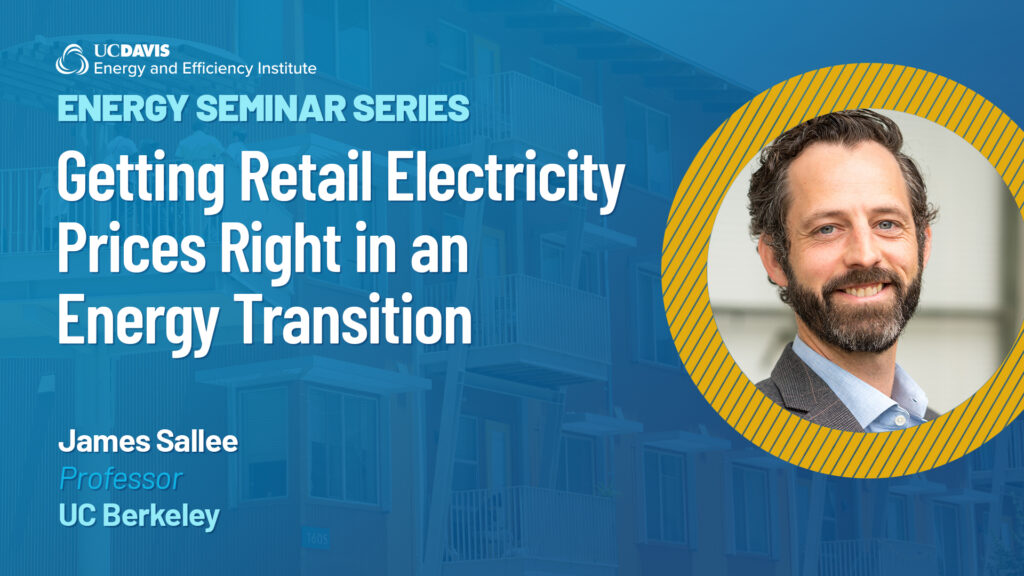
Decarbonization depends on households switching from fossil fuels to electricity, so the price of electricity is a crucial lever. In such a context, how should prices be set? Economists default to a simple rule: price each kilowatt-hour at its social marginal cost, which is the cost of providing one more unit of electricity to a customer, inclusive of environmental damages. Actual prices deviate from this benchmark, but it would be feasible to reform rates towards the economist’s ideal. This talk starts from this economist benchmark and asks what it would mean to follow this advice. Should we actually pursue such a goal? It covers three questions. First, how can utilities move to efficient pricing without creating inequity? Second, what would efficient pricing mean for heat pumps? Third, what competing fuels (natural gas, gasoline) are themselves mispriced? Answering these and other questions can help us better what role retail electricity prices play in a clean energy transition.
James Sallee is a Professor at the Haas School of Business in the Economic Analysis and Policy Group and a Professor in the Department of Agricultural and Resource Economics at the University of California, Berkeley. He is an applied economist who studies topics related to energy, climate, the environment and taxation. Sallee was the founding co-director of UC Berkeley’s Master of Climate Solutions, a professional master’s degree that trains students who want to be part of the solution to the climate crisis. Outside of academia, Sallee is an Amazon Scholar, where works on the company’s efforts to decarbonize.