- Home
- »
- Education
- »
- Energy Graduate Group
- »
- FAQ
FAQ
For Applicants: General Information
1. What is the focus of the Energy Systems program?
The Energy Systems program at UC Davis seeks to prepare students and professionals with the knowledge, skills, and training needed to advance the energy sector. The program is unique in its approach because it is highly interdisciplinary in nature, and as a result has produced leaders in the energy field across many different sectors including government, industry, and academia.
2. Who is the ideal candidate for this program?
The ideal candidate for our MS or PhD program in Energy Systems is an individual with a background in engineering, environmental sciences, computer science, social sciences, or policy, who has a strong interest in sustainable energy solutions. This program is designed for those who are driven by the challenges of enhancing energy technologies and striving for a sustainable energy system. We value candidates who bring diverse perspectives and are committed to advancing both the technical and societal aspects of energy systems.
3. What are the career opportunities available after completing this program?
Admission Requirements
4. What are the prerequisites for applying to the program?
5. Is work experience required for admission into the program?
6. What documents are needed for the application?
See application checklist: https://energy.ucdavis.edu/education/energy-graduate-group/apply-to-the-energy-graduate-group/ (link? Or just provide directly here) Complete the UC Davis online application.
- Request and submit three letters of recommendation.
- Submit a Statement of Purpose and Personal History Statement.
- Upload academic transcripts from all prior institutions.
- Pay the application fee. ($135 for U.S. residents or $155 for international students)
- Send required English language test score to UC Davis. (International students only)
- Need funding?
Application Process
7. How can I apply, and when are the application deadlines?
To apply, go to the Graduate Studies online application and submit all required items in the checklist above. There are two deadlines: 1) January 15 – the priority deadline where applicants will receive a priority review. Apply by this date for funding consideration . PhD appliants should apply by this date. 2) April 1 – this deadline will not be reviewed on a priority basis. Late applicants past April 1 will only be considered if the graduate program determines that there is additional space available.
8. Are there any scholarships or financial aid available for this program?
Yes, applicants are eligible to receive fellowships. In fact, the majority of EGG students (both Masters and PhDs) receive (but are not guaranteed) some type of funding offer to to cover part of their graduate program costs.
9. Who can I contact for more information about the application process?
Contacts for the application process:
Alan Meier (Admissions Chair) akmeier@ucdavis.edu
Alan Jenn (Program Chair) – ajenn@ucdavis.edu
Program Details
10. What courses will I need to complete for the Master’s and Doctoral program in Energy Systems?
The course requirements can be seen below:
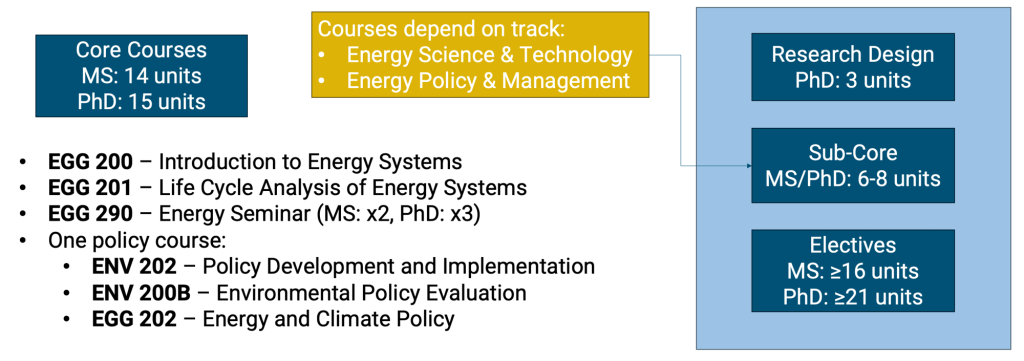
Generally speaking, MS students must take either 36 units (if they are on Plan I: Thesis Track) or 38 units (if they are on Plan II: Comprehensive Exam Track). PhD students are expected to complete 45 units to finish their course requirements.
11. Can students customize their course load or specialize within the program?
12. What is the duration of the program?
For Current Students
1. Who can I talk to for academic advising within the Energy Systems program?
Major Professor – The major professor is your primary advisor for research and will provide guidance in putting together your thesis (MS) and your dissertation prospectus and dissertation (PhD). They will also provide advice on classes that may complement your research during your graduate career.
Graduate Advisor – The graduate advisors’ primary duty is to work with you to design a program of study. This will ensure that you fulfill both your course requirements while simultaneously meeting your interests and research needs. The current graduate advisors are: Prof. Julia Fan (Science and Technology Track – jzfan@ucdavis.edu) and Prof. Frank Loge (Policy and Management Track – fjloge@ucdavis.edu). Prof. Alan Jenn (ajenn@ucdavis.edu) and Prof. Alissa Kendall (amkendall@ucdavis.edu) can both act as graduate advisors as well.
Graduate Program Coordinator – The grad program coordinator is the primary point of contact for administrative and student support needs of the student. If you need guidance on policies, procedures, required paperwork (i.e. program of study, committee membership, etc.), please contact Professor Alan Meier (akmeier@ucdavis.edu) is the coordinator for the EGG program.
Chair – The chair manages the program, essentially making sure that things are happening the way they should. If students have any concerns related to the program, they can reach out to the chair to discuss. The current chair of EGG is Alan Jenn (ajenn@ucdavis.edu).
Graduate Student Representative* – Graduate student reps are not official advisors in any capacity, but are nonetheless valuable sources of information from your peers. Consider talking to your rep for advice!
2. How do I choose my thesis topic or project?
3. Are there mandatory courses or credits I need to complete?
Generally speaking, MS students must take either 36 units (if they are on Plan I: Thesis Track) or 38 units (if they are on Plan II: Comprehensive Exam Track). PhD students are expected to complete 45 units to finish their course requirements.
4. How can I get involved in faculty research projects?
5. What opportunities are there for internships or industry collaboration?
6. What funding opportunities are available to me?
- Graduate Student Researcher (GSR): This role involves working on research projects under the guidance of a faculty member, often directly related to your thesis or dissertation. It not only provides a stipend but also often covers tuition costs. GSR positions are excellent for gaining hands-on experience in your field of study while contributing to significant research outcomes.
- Teaching Assistant or Reader: As a Teaching Assistant (TA), you will assist professors with the delivery of courses, including leading discussion sections and managing laboratory work. Readers are primarily responsible for grading assignments and exams. Both roles offer a stipend and, in many cases, tuition remission. These positions are perfect for those looking to enhance their teaching skills and understand educational processes in higher education. Note: TA positions are housed in academic departments with undergraduate programs. Graduate groups do not have TA or reader positions.
- Fellowships: The program offers various fellowships, both internal and external, to support your studies. Internal fellowships are funded by the university or specific departments and are awarded based on academic merit or financial need. External fellowships are available through industry partnerships, professional associations, and government agencies, providing additional opportunities for financial support and professional development.