
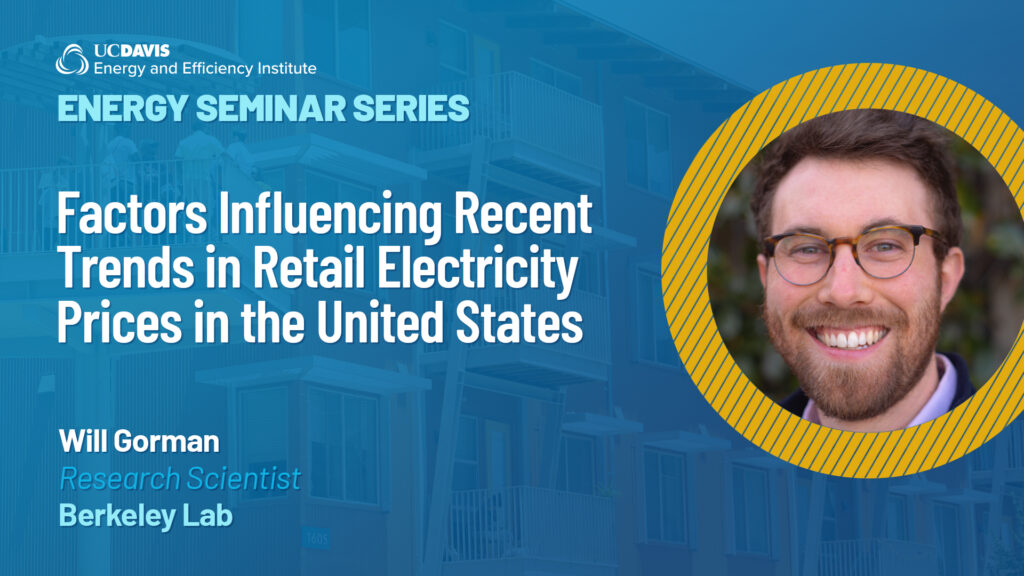
U.S. retail electricity prices have largely tracked inflation in recent years, yet significant regional variations have left a few states facing steep price increases. Simultaneously, the power sector is undergoing a rapid transformation driven by wind and solar energy integration, extreme weather risks to and from grid infrastructure, and the return of load growth – a convergence that frequently leads commentators to oversimplify or misattribute the root causes of rising rates. Misdiagnosing the factors that influence price increases risks misguided regulatory decisions that compromise customer affordability. In this talk, I outline the primary factors shaping recent trends in U.S. retail electricity prices. By decomposing underlying utility cost structures across generation, transmission, and distribution components, I identify the key factors behind state-level price divergences. The relative influence of these factors varies across states and over time, and though relationships may change in the future, the findings underscore a diverse set of price determinants and highlight the need for nuanced empirical research to inform targeted policy that can improve energy affordability.
Bio: Will Gorman is a Research Scientist in the Energy Markets and Planning Department at Berkeley Lab where he focuses on the interconnection of new supply into the electric power system, retail electricity prices, and the application of energy storage within electricity systems. In his work, Will particularly seeks to inform public and private decision-making within the U.S. electricity sector through economic analysis. He has published his research in Joule, Applied Energy, Energy Policy, and Energy Economics among other journals, and has been invited to speak in front of FERC. Previously, Will worked with the utilities practice at The Brattle Group, where he focused on wholesale electricity markets and retail rate design. Will has a Ph.D. in Energy and Resources from the University of California, Berkeley. He holds a B.S. in Chemical Engineering and a B.A. in Plan II Honors from the University of Texas at Austin.