
Energy system optimization is a key tool for designing sector-coupled energy systems. But what should we optimize, over which time horizon, and how do we handle uncertainties inherent in planning decades ahead? This talk addresses these three questions.
First, objectives: beyond cost, we integrate life cycle assessment to capture environmental impacts along supply chains. We then move from relative comparisons towards absolute sustainability: can energy systems operate within planetary boundaries?
Second, time: instead of optimizing a single future snapshot year, we optimize the entire transition pathway from today’s status quo. Our time-explicit life cycle optimization framework captures how technologies, supply chains, and emissions evolve over time.
Third, uncertainty: over decades, technology costs, energy demand, prices, policies, and weather are all uncertain, and every model simplifies reality. Rather than trusting a single “optimal” solution, we explore near-optimal alternatives and stochastic optimization to design resilient systems under uncertainties and component failures. The result is a set of robust options for decision-makers.
One key finding: staying within planetary boundaries likely requires negative emissions, for example from direct air carbon capture and storage (DACCS). Finally, I show how combining experimental material characterization, process optimization, and systems analysis reveals how flexible DACCS operation under varying weather and electricity prices can enable low-cost negative emissions.
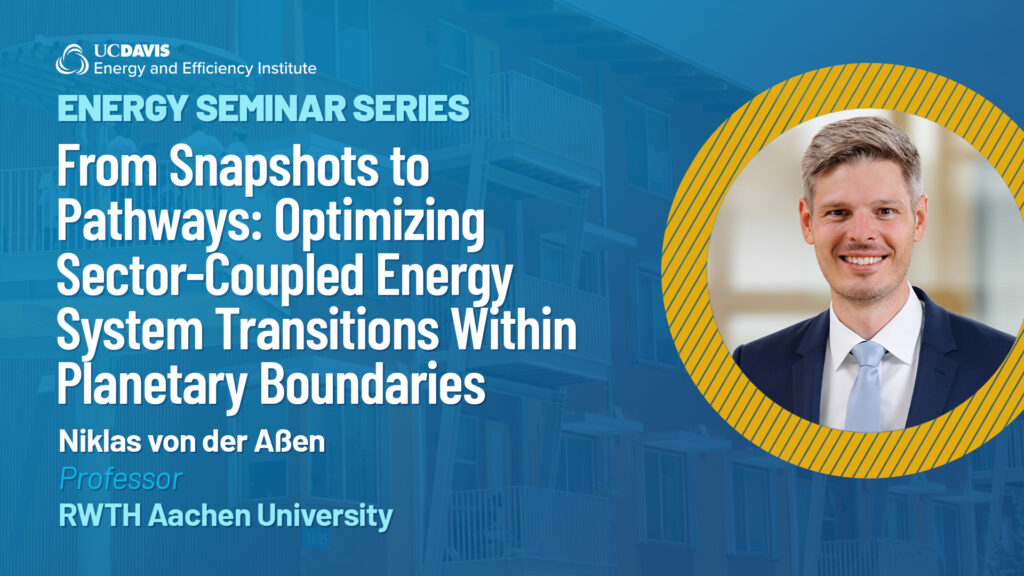
Niklas von der Aßen is a university professor and head of the Institute of Technical Thermodynamics (LTT) at RWTH Aachen University. He studied mechanical engineering and economics at RWTH, with study periods at the University of California, Davis (2007/2008), and Universitat Rovira i Virgili in Spain (2009/2010). His PhD at LTT/RWTH analyzed CO2 as a feedstock for polymers and chemicals, while he co-founded and led the institute’s Life Cycle Assessment group. From 2016 to 2019, he worked as a sustainability consultant at Bayer AG. He then returned to the LTT as assistant professor for “Sustainable Life Cycles in Energy, Chemical and Process Engineering.” From 2021 to 2024, he served as one of RWTH’s three rector’s delegates for sustainability. His research integrates thermodynamics with life cycle assessment and systems optimization to design climate-friendly energy systems, chemical processes and products, aiming to make a measurable contribution to a sustainable economy.