
May 14, 2026 | 12PM-1PM | EEI Conference Room and Zoom
Join us Thursday, May 14 at EEI for our weekly Energy Bites lunch seminar, featuring two presentations on residential electrification, distributed energy systems, and grid impacts. These talks will explore how emerging technologies and policy changes are shaping the future of energy use and decarbonization.
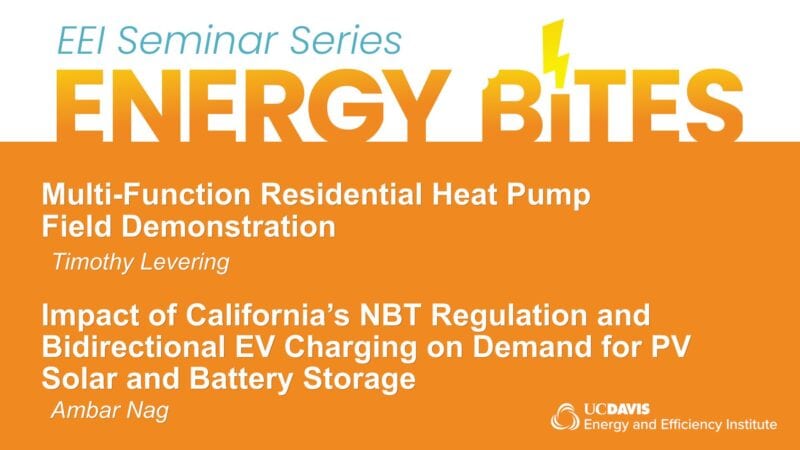
Multi-Function Residential Heat Pump Field Demonstration
Timothy Levering
Multi-function heat pumps (MFHPs) combine space conditioning and domestic hot water heating into a single integrated system, with the potential to improve efficiency and reduce peak electrical demand in residential buildings. This presentation will highlight ongoing field demonstrations of MFHP systems and explore their potential role in supporting residential electrification and building decarbonization in California.
Timothy Levering holds an M.S. in Mechanical Engineering from California State University, Sacramento, with a specialization in thermal and fluid systems, as well as a Certificate in Scientific Computing and Simulation. Before joining the Western Cooling Efficiency Center in 2022, Timothy worked as a project manager with the California Independent System Operator (California ISO). His current research focuses on improving building efficiency and advanced residential energy technologies.
Impact of California’s NBT Regulation and Bidirectional EV Charging on Demand for PV Solar and Battery Storage
Ambar Nag
In April 2023, the California Public Utilities Commission adopted Net Billing Tariff (NBT), significantly changing the economics of residential distributed generation and battery storage systems (BESS). Meanwhile, emerging technologies such as bidirectional EV charging have the potential to reshape economic incentives and create noticeable grid impacts as adoption increases.
This presentation analyzes trends in rooftop solar and BESS adoption, comparing customers on NBT to those on NEM2. It uses economic benefit-cost analysis to evaluate payback periods and return on investment, and examines the least-cost charging behavior of bidirectional EVs under different tariff structures to better understand potential grid impacts at scale.
Ambar Nag is a graduate student in Environmental Policy and Management with interests in energy systems and decarbonization. Prior to UC Davis, he worked as a data scientist across consulting and product management. As Greenhouse Gas Inventory Analyst for UC Davis Sustainability, Ambar supports development of the campus Climate Action Plan and tracks progress toward institutional net zero goals.
Lunch will be provided for in-person attendees. Please register in advance so we have an accurate headcount.
We look forward to seeing you!