

The EEI hosts and participates in a number of energy-related events each year. These events include everything from large, international conferences to small, focused workshops. Many of our events are open to the public.
See our upcoming events or view our past events.
To receive event announcements, please join our mailing list.
Upcoming Events
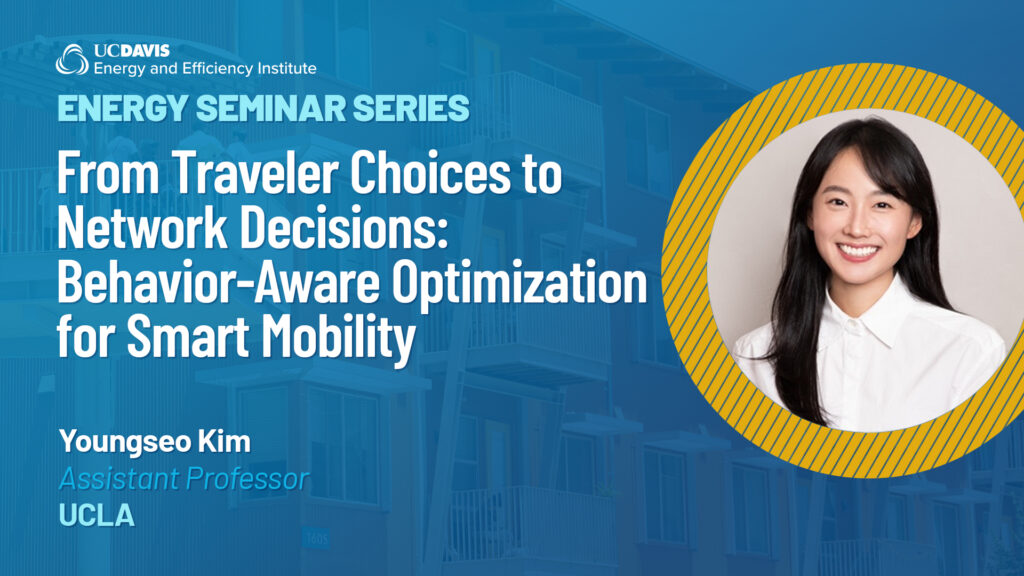
Traveler choices shape network flows, while network conditions and mobility service operations influence those choices. Together, these interactions determine not only accessibility and congestion but also transportation energy use, making behavior-aware optimization essential for designing efficient and sustainable mobility systems. Logit-based choice models are often embedded in optimization through nonlinear constraints or bilevel formulations, creating computational difficulties for both behavioral characterization and system design. This talk presents the Primal-Dual Maximum-Utility Structured Estimator (PD-MUSE), a convex programming framework for representing and estimating logit-based discrete choice models. The convex structure enables computationally tractable characterization of traveler behavior, while duality allows behavioral parameters to be recovered from a single optimization solve. Our framework provides a modular representation of traveler behavior that can be embedded in broader network optimization problems. By representing travel patterns as flows, it models behavioral responses at the network level and supports behavior-aware optimization when service levels and traveler choices are coupled. We explore various applications in travel demand modeling, transit operations, mobility-on-demand dispatching, vertiport location planning for air mobility, and curbside pricing. These applications illustrate how the framework can support behavior-aware mobility decisions and provide a foundation for evaluating their implications for energy use and emissions.
Youngseo Kim is an Assistant Professor in the Department of Civil and Environmental Engineering at UCLA. She leads the HUMAN Lab (Human Understanding in Mobility and Automation in Networks), which focuses on solving design and operational problems in complex, interconnected transportation and logistics systems, with a particular emphasis on human behavior and demand uncertainty. She aims to build innovative, human-centered urban mobility systems with a focus on accessibility and sustainability. Her lab develops efficient computational tools and algorithms to support decision-making in transportation systems. Prior to joining UCLA, she completed her Ph.D. in Transportation Engineering at Cornell University, advised by Professor Samitha Samaranayake. She was a visiting student at the Laboratory for Information and Decision Systems (LIDS) at the Massachusetts Institute of Technology (MIT), hosted by Professor Cathy Wu. She received an M.S. in Civil and Environmental Engineering from Seoul National University (SNU) in 2020, advised by Professor Dong-Kyu Kim. She also holds a B.S. in Civil and Environmental Engineering from SNU, conferred in 2018.

Researchers from UC Berkeley, UC Davis, and Stanford analyzed nine years of thermostat data from 1,263 California households and sorted them into five behavioral types.