
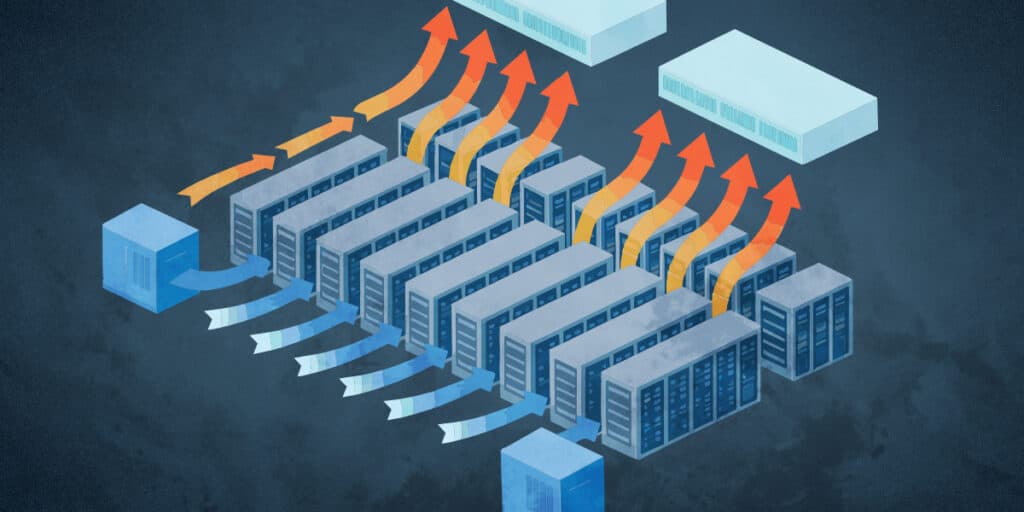
California’s two largest utilities are projecting tens of billions in grid upgrades to accommodate surging data center demand driven by AI workloads. Traditional air cooling, which can consume up to 40% of a facility’s total electricity, is increasingly insufficient for AI racks exceeding 100 kilowatts — well above what air can reliably handle.
The paper, published this month in the ACEEE Summer Study on Energy Efficiency in Buildings, compares seven cooling strategies — from traditional air systems to direct-to-chip (D2C) liquid cooling and full immersion tanks — across energy efficiency, compute density, retrofit difficulty, cost, and environmental impact.
Full D2C liquid cooling, which pipes coolant directly to CPUs and GPUs, uses 93% less secondary-loop cooling energy than conventional air cooling and can pack roughly 15 times more compute into the same floor space. The tradeoff is that it requires specialized server hardware, extensive plumbing, and significant upfront investment — making it impractical for most existing facilities.
For operators who can’t rebuild from scratch, hybrid approaches that combine D2C cooling for processors with traditional air cooling for auxiliary components deliver meaningful efficiency gains at moderate retrofit complexity. The researchers single out D2C paired with rear-door heat exchangers as a particularly practical option for facilities where existing cooling capacity is running short.
The researchers at the UC Davis Western Cooling Efficiency Center note that their analysis was limited to single-phase liquid cooling. As next-generation GPUs push heat output even higher, they say two-phase cooling systems will need the same rigorous evaluation.